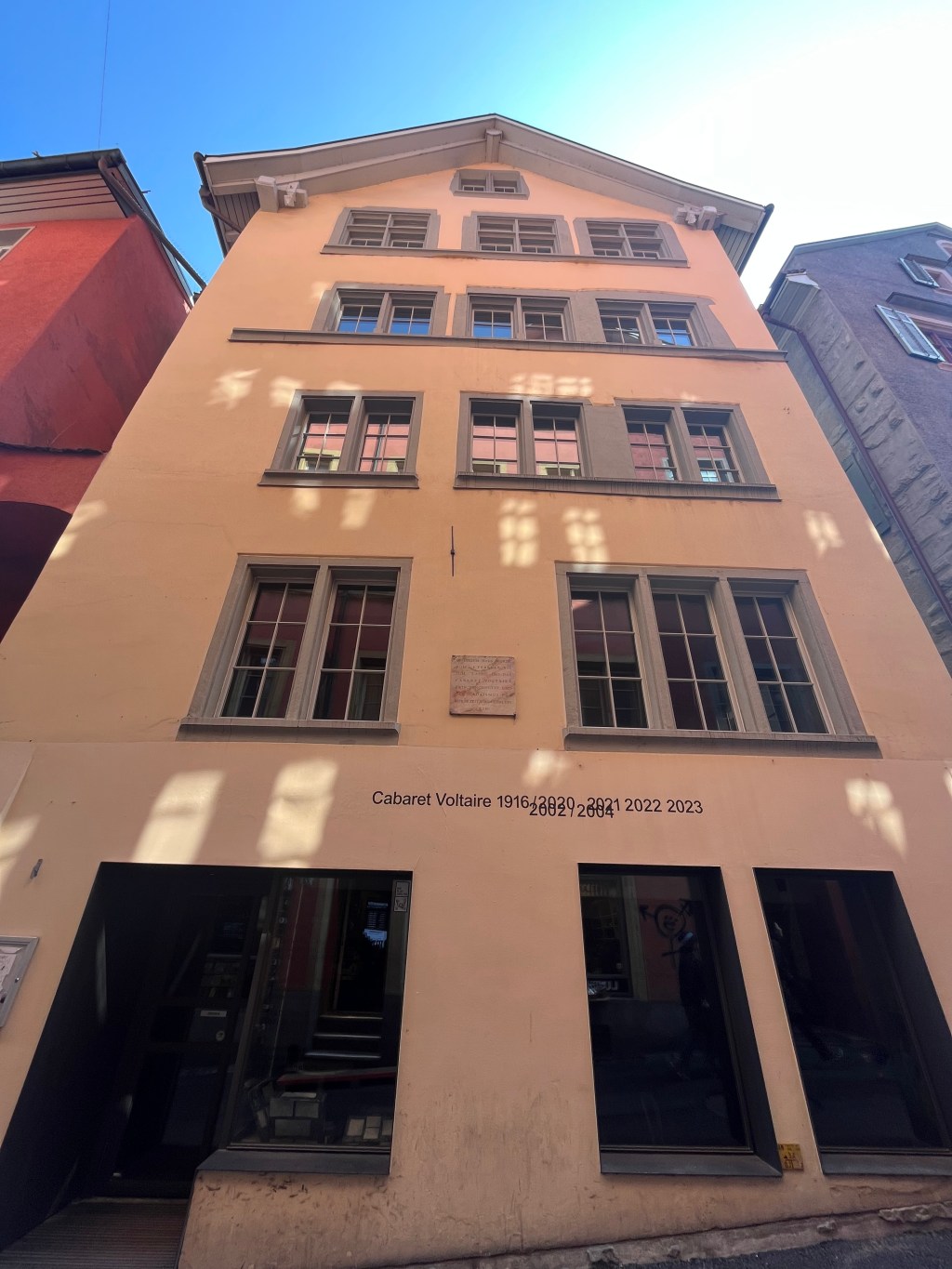
When visiting Zurich, one of the most intriguing spots on the cultural map is the Cabaret Voltaire. This historic venue, founded in 1916, is not only the birthplace of the Dada movement but also a testament to the radical spirit of artistic innovation.
I researched the Cabaret Voltaire and spent a lot of time there when I was writing my novel, “What was Beautiful and Good.”
Here’s some insight into the Cabaret, which can deepen your experience of its iconic legacy.
The Birthplace of Dada
Cabaret Voltaire was established by Hugo Ball and Emmy Hennings as a place for avant-garde performances and artistic expression. It became a hub for poets, artists, and thinkers who challenged the norms of society and art, making it a vibrant hotspot for creativity. When you step inside, you’re walking through a space that has seen revolutionary performances, controversial art, and a bold reimagining of what art can be.
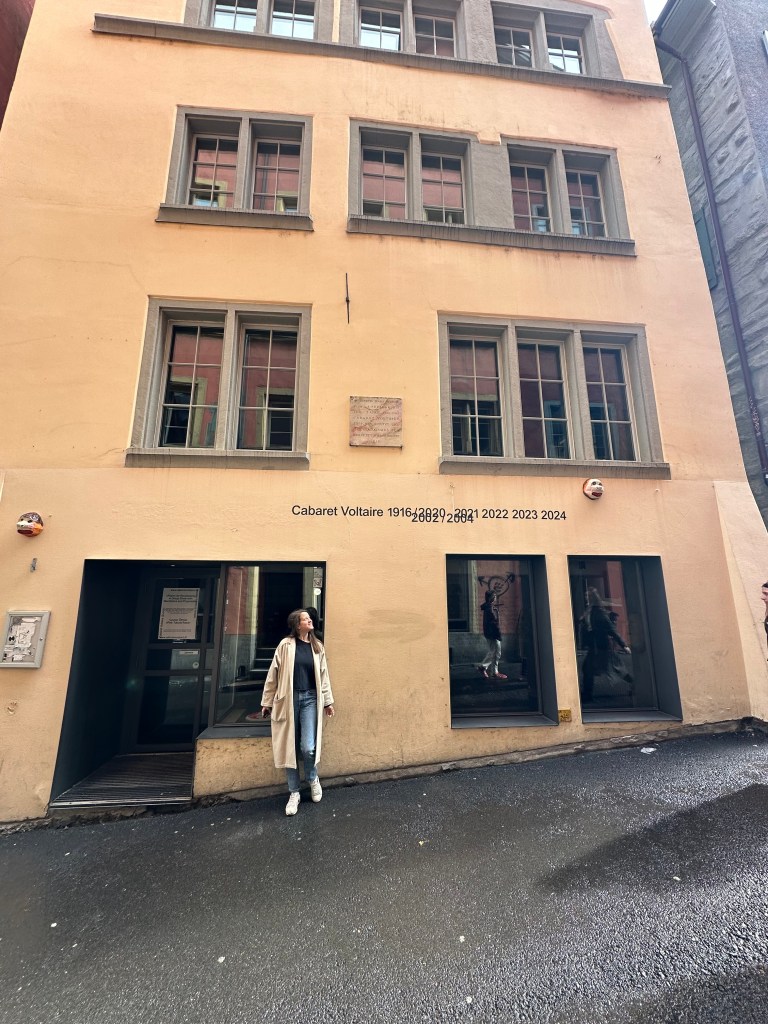

(That’s me in the photo on the left, and on the right, the painting “NICHT WEISS, NICHT SCHWARZ, SONDERN DAS GEGENTEIL,” (2024) by Cristina Ruiz de Castañeda Fleischmann, inspired by the novel, “What was Beautiful and Good.”)
What to Expect on Your Visit
The Atmosphere
The Cabaret Voltaire has had many identities over the years, but it’s currently set up as a cultural venue and art space, under the director Salome Hall and supported by the City of Zurich.
When you arrive at Spiegelgasse 1, you will directly enter into a bar and gathering area. You can order a drink and sit down at one of the tables on the first floor, or make your way inside. (You will probably want to also say hello to whomever is working behind the counter. Let them know if you’re a toursist/interested in the history/or just want to have a drink in the historic hall. If they’re friendly, they’ll have some insights for you.)
On the lower level is a gallery space, the “Vaulted Cellar”. The current exhibition is a dialogue on contemporary cinema called «Interlude: Act 2, Hold The Sound – BaseCamp Library», but you can find the updated exhibitions program for that on the Cabaret Voltaire website.
Upstairs, you’ll find the “Historical Hall” — or the original Cabaret Voltaire. The Dadaists rented this area for the cabaret from February 5 to June 23, 1916. The experience you’ll have in the Historical Hall will may be dependant on what events are happening. It may be set up as a gathering space for students/artists/ the community, or there may be a private event. There is typically a piano in the room – a nod to founder Hugo Ball, and some art on the wall that depicts the original use of the space.
From the CV website: “Today, the column in the front part of the hall is the only thing left of the original construction. On the left side of the room stood—as today—a small wooden stage on which experimental and interdisciplinary performances were shown. Poems were performed simultaneously in different languages, in combination with masks, dance, stage sets and music.
“At that time, there were also works of art hanging on the walls, including some by Picasso. A highlight of Cabaret Voltaire was the performance of Hugo Ball on June 23, 1916, when he performed his sound poems in a cubist costume as a magical bishop and experienced his mystical enlightenment.”
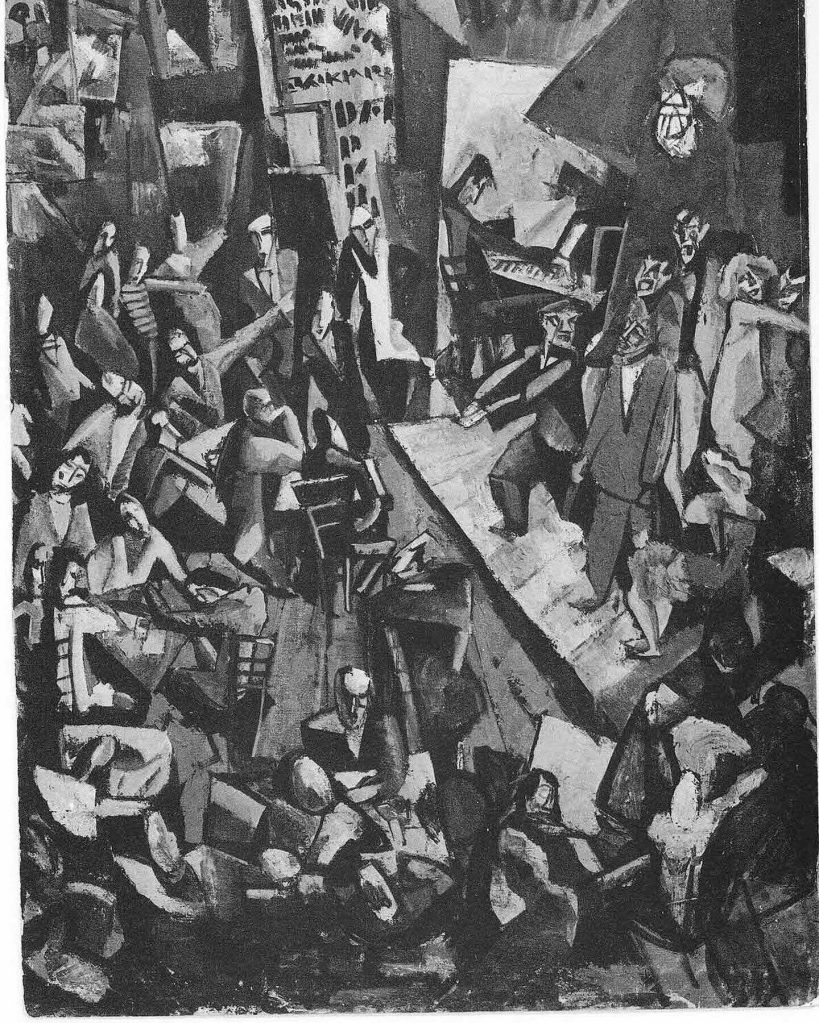
Marcel Janco, Cabaret Voltaire, 1916, Photo print of the lost oil painting, formerly Arche Verlag, Zurich / Hamburg
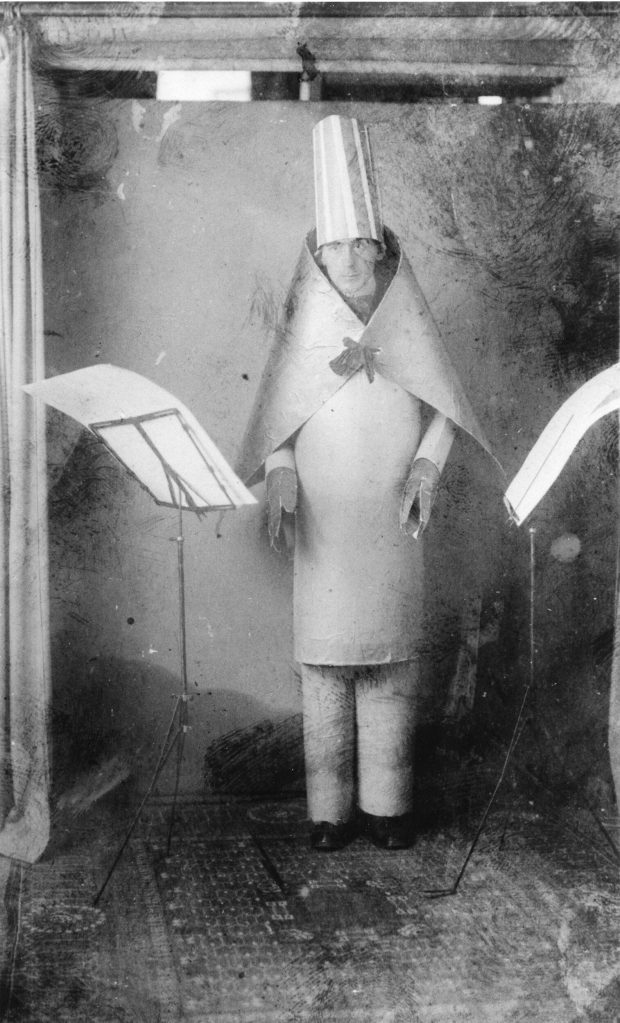
Hugo Ball, the passionate co-founder of Cabaret Voltaire
If you want to know more about the energy and the vibe of the original Cabaret Voltaire, I tried to capture it in my novel.
Events and Exhibitions
Cabaret Voltaire regularly hosts performances, exhibitions, and workshops.
Check their schedule to see what events align with your visit. Engaging with these activities can provide deeper insights into the Dada movement and its lasting influence on modern art.
You can also follow the @CabaretVoltaire on Instagram for updates.
Dada Library
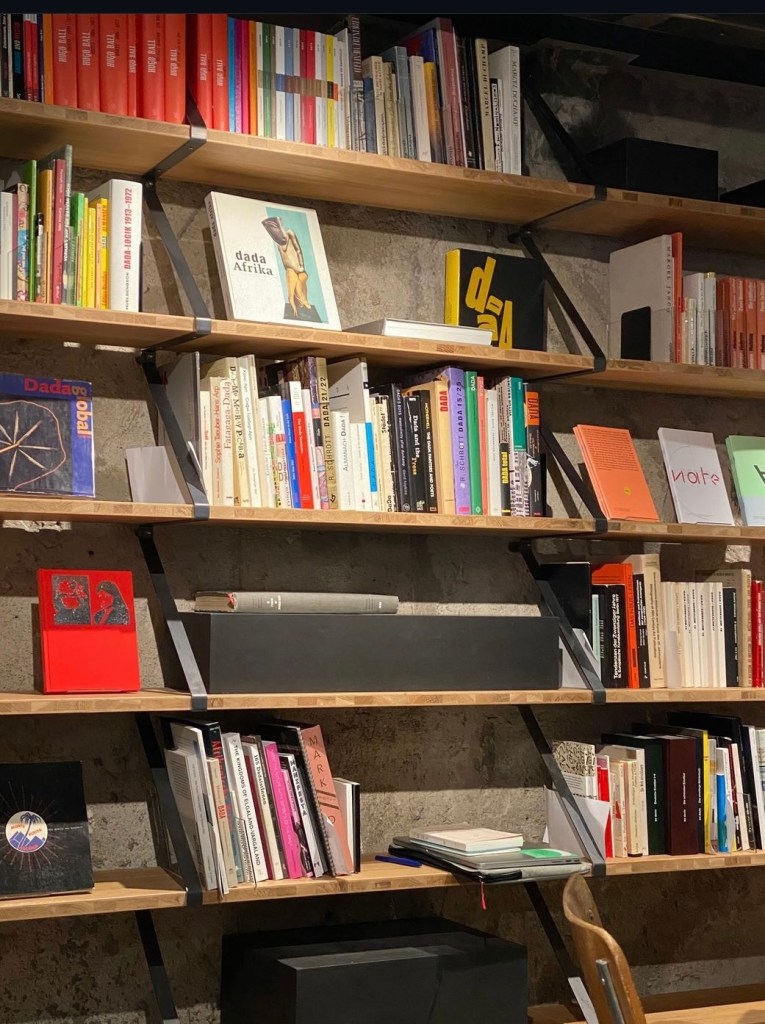
The Dada Library is located on the second floor of the Cabaret Voltaire. The library contains significant Dada-publications — including my novel in German, “Was schön war und gut.”
From the CV website: “Throughout the day, the library can be used as a workspace and is available for meetings, while it turns into a part of the wider bar area in the evening. Another part of the library is the newly created research display, a wooden construction in which valuable books and Dada first editions or facsimiles of letters and photos can be exhibited. In addition to this, important books on current exhibitions as well as mediation material are presented.”
Connecting Past and Present
Cabaret Voltaire stands as a bridge between the past and the present, encouraging visitors to think critically about the role of art in society. The Dada movement’s emphasis on spontaneity and absurdity invites us to reconsider our perceptions of beauty and meaning. By engaging with the exhibitions and performances, you can gain a richer understanding of how these ideas are still relevant today.
Visiting Cabaret Voltaire is more than just a trip to a historic site; it’s an opportunity to engage with a pivotal moment in art history. Embrace the chaos, the creativity, and the conversations that arise. As you leave, take with you not just memories of this vibrant space, but also reflections on the broader questions of art and life.
I hope you have a great time at the Cabaret Voltaire and during your trip to Zürich!
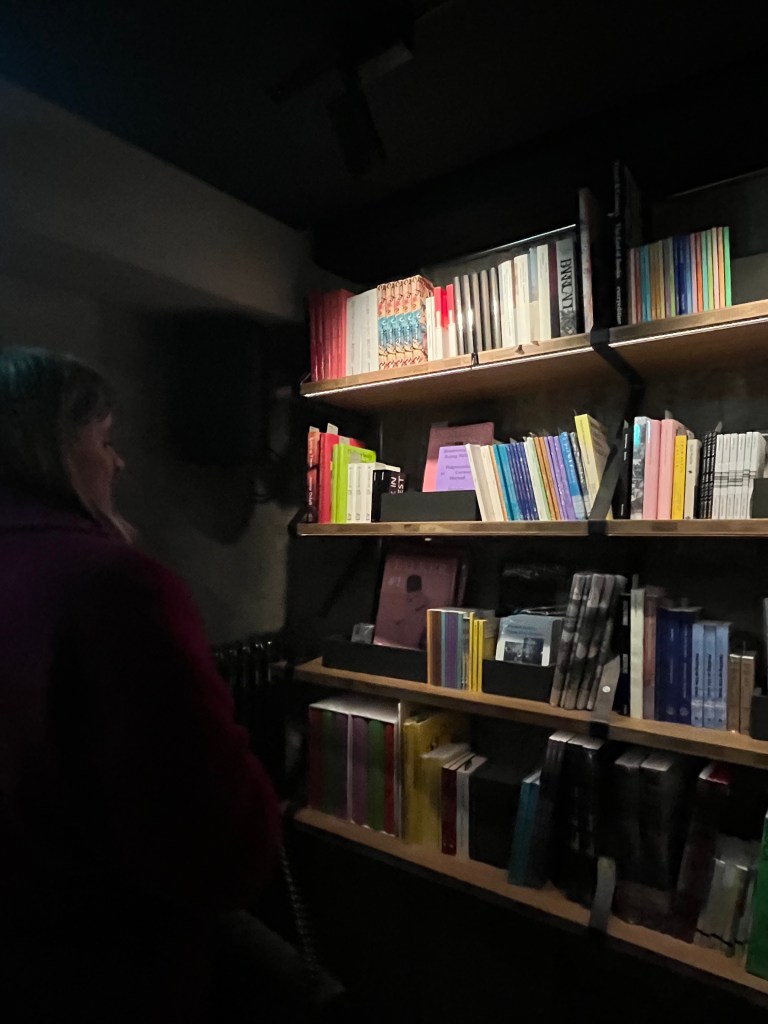
Oh, and on your way out, you can find my book and others on sale on the CVBooks bookshelf by the main entrance!
VIVA DADA!
CVBooks, Cabaret Voltaire, Zurich, Switzerland
Opening hours exhibitions and Dada Library:
Tue–Thu, 17:00–20:00
Fri, Sat, 13:30–18:00
Sun, 13:30–18:00
Or upon request.
Opening hours Bar:
Tue–Thu, 17:00–23:30
Fri, Sat, 13:30–01:30
Sun, 13:30–18:00
Prices:
Admission house – free of charge
Exhibitions in the Vaulted Cellar – CHF 7/4
Events – see respective announcement
Cabaret Voltaire
Spiegelgasse 1
8001 Zürich
Office: +41 43 268 08 44
info@cabaretvoltaire.ch
 Jill Blocker
Leave a comment